Career Review
Check out the Career Review Podcast
https://prezi.com/4xf4tfb8bzke/career-review-interviewing-dr-elizabeth-lopez/#
Interview Summary
Interviewee: Dr. Elizabeth Lopez/Professor of English: Rhetoric & Composition Division/Director of Lower Division Studies
Interview Setting: Interview conducted in Dr. Lopez’s office on the 22nd Floor of the Suntrust Building on 22 Park Place. The interview was conducted at 10:30 AM on Monday morning, 03/29/16.
Affiliation with interviewee: Dr. Lopez has been my professor for three classes. I have also spoken with her privately regarding attending graduate school and areas of study.
As an essential piece to completing my career review project, I interviewed Dr. Elizabeth Lopez, who is a professor of Rhetoric & Composition at GSU. My concentration in the English Department is Rhetoric & Composition, and because Dr. Lopez does teach in this field and also teaches in other English-related courses, it seemed only right to interview her considering that she obviously has a good understanding of what the English field entails. As it turned out, she has so much experience as a writer, orator, and researcher, and she is also the Director of Lower Division Studies.
Dr. Lopez began the interview by listing her many positions and responsibilities of a tenure track professor. I told her that I was interested in knowing what to expect and where to look in order to establish a career as an English Professor of Rhetoric & Composition. I posed a question of how might someone go about entering this career. As she responded, she strongly emphasized the fact that I would need a Ph.D if anything, but to keep in mind that there are some universities who hire prospective teachers who have just a Master’s Degree.
Throughout the interview, Dr. Lopez kept consulting different writing communities and committees that most teachers found interesting or would have to be a part of, e.g. The National Council of Teachers of English. She insisted that, “it is another way to…be connected with professionals in your field, to understand what the field is doing, but also to get some information about jobs and positions. And this was the part of the interview I found most surprising because I had never really heard of my professors speaking of this, so I felt a bit lost at first, but quite intrigued at the same time. Dr. Lopez also said that tenure track professors have a lot of flexibility and full autonomy. I mentioned that I had thought teachers in general had no balance between work and life, but I was wrong. She said that her life is not structured like a typical “9-5” job and that the more structured part of her week is meeting with the classes she are assigned to every time they have to meet.
One other aspect of the interview I wanted to note was that throughout the entire thing, Dr. Lopez kept reiterating how rigorous the tenure track review process is. It seems almost intimidating at first, but I’m pretty sure with having a lot of experience with writing and research, the process would not be as intense. But, regardless of the amount of work it takes, the rewards are well worth it.
Overall, I expect that this interview will really help me complete my project considering that she had given me more than enough content to work on as I develop the narrative behind it. Moreover, Dr. Lopez was able to point me towards other resources I will be able to use and apply whenever I finally decide to become a professor at a university.
Word Count: 500
Lemire, Timothy. (2006). I’m an English Major – Now What?. Cincinnati, OH: Writer’s Digest Books.
ISBN – 13:978-1-58297-362-3
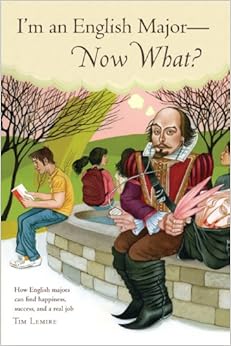
I’m n English Major – Now What? Author – Tim Lemire
In Timothy Lemire’s I’m an English Major – Now What?, he offers an insightful and personal perspective of the misconceptions, potential fears, common questions, and sought/unsought opportunities available for the English Major. This book serves an excellent resource to prospective and current English Majors who are near or far from graduating. In reviewing Lemire’s book, the criteria included content, testimonies (personal and impersonal), organization, and “try-this” segments that occasionally interrupts the reader’s reading, but more importantly, they are extremely helpful. Regarding universities, however, Lemire make references relevant to the past years and the limited courses offered in the English field. But, today, of course, more English classes (e.g. technical writing, and grant writing) are offered at most universities that prepares the English student for a specific occupation after graduation. Despite Lemire speaking on facts relevant in 2006, the majority of the information he provides remains very helpful.
The organization of this book allows the reader to randomly navigate from each of the 10 chapters considering that they are in topical order in the Table of Contents. So, the reader is not forced to read the chapters chronologically from 1-10 in order to comprehend the books content, but rather start reading a chapter that interests them more. Each chapter is composed of either; defining side-note sections; conversations with past/current English Majors; a list of skills and activities; Q&A’s with successful celebrities; and the best advice that Lemire claims to have ever gotten from seasoned professionals. These firsthand accounts lend deeper insight into factual and practical situations.
Being an English Major, I have experienced the feeling of not being so sure about what I want to do after I graduate except teach. In Chapter 2: Perchance to Teach, he talks about teaching being the only option for English students, not because they wanted to teach necessarily, but more so because teaching is what people forced the English Major into believing that that was the only and obvious job available for them. Aside from the most important skills a teacher should possess (e.g. organization, focus, and patience), Lemire suggests that teaching in and of itself is “a continual learning process.” He insists that if you are an English Major who genuinely wants to teach then do so, but do not go into the world of academia out of sheer desperateness. In addition, Lemire provides detailed encounters he had with young and mature English majors. Take for instance his conversation with a young man who was very interested in animals. From there Lemire suggested that he takes interest in writing for a zoo or travel industry. This advice excited the young man virtually making him rethink how he could use his skills.
I’m an Englsih Major – Now What? is an extra resource for English Majors outside of academia and what a Google or yahoo search engine can provide. The author, Timothy Lemire, teaches the reader how to market his/her skills, and to know what to expect when going into an unfamiliar field, overall making this book and excellent read.