Bite Force of American Cockroach Studied

Throughout the semester, I have tried to educate you on Periplaneta americana, the American cockroach. We have touched on their habitats, diet, reproduction habits, and physical appearance. Going deeper into physical appearance, I introduce to you a scientific article that tests the mandibles and bite force/strength of the American Cockroach. Mandibles on the American cockroach are appendages attached to their jaw for catching, crushing, and grasping food. 

The peer-reviewed scientific article titled ” Fast and Powerful: Biomechanics and Bite Forces of the Mandibles in the American Cockroach Periplaneta americana” written by Tom Weihmann, Lars Reinhardt, Tobias Siebert, and Benjamin Wiplfer, was made to explore and understand the strength of the American Cockroach mandibles. To conduct the study, the researchers measured both the active bite forces and passive forces from joint resistance which were recorded/measured using a 2D force transducer and a Fastcam SA3 Video System. The researchers hypothesized that the data from this experiment would confirm that American cockroaches have similar mandible closing stress values to stag beetles and ground beetles. The main focus of the study was to understand the capabilities and limitations of the cockroach mandibles.

For the experiment, 10 adult cockroaches had a camera attached to them and they were all allowed to bite a sensor tip (metal apparatus that could measure bite strength). The cockroaches were tied down and in front of them was a sensor tip held together by dental cement for the cockroaches to bite on (since bite marks can easily be visualized) to measure voluntary bite activity and upper bite force limit for one hour, with 60-second intervals throughout. The cockroaches had a device attached to their jaws that controlled the angles their mandibles were able to open and close; the angles were increased and decreased randomly.  After the cockroaches were allowed to voluntarily bite, they were euthanized by being frozen and their mandibles were forced open to test the passive forces resisting mandible opening. The results showed that the cockroaches rarely used all of their bite strength or mobility and in a 60-second interval, only reached their max bite force twice during voluntary biting. Maximum bite values were measured at 0.92 N, but the average plateau of the bite values was about 0.60 to 0.75. The left and right mandible was measured separately, but the max values for both were nearly identical. Looking at the results of the dead cockroaches to measure inactive or passive force, the passive forces increased as the angle of the mandibles increased. 

The force of the mandible bites was calculated using kinematics, a branch of physics that focuses on the motions of objects, in this instance, the bite of the cockroach mandible. The kinematics were gathered using the video system camera that was attached to the cockroaches to watch their movement and the angles at which their mandibles were opened. A key point of this study was the understanding difference in mandible force during the active moment and passive movement when the cockroaches were dead. This was very important to consider because the focus of this study was figuring out the limit of the cockroach mandibles. While studying their voluntary movement helped the researchers see their average force (how they operate on the day-to-day), the joint resistance helped the researchers see the maximum force of their bite. 

The authors’ hypothesis was that the mandible bite force of American cockroaches would be similar to those of stag beetles and ground beetles. The results show that their mandibles are quite similar to ground beetles, but not so much to stag beetles. These results are interesting because cockroaches and beetles are in two different orders; cockroaches in Blattodea and beetles in Coleoptera. This then brings up the question of, what common ancestor do these two share that allowed them both to develop similar jaw appendages such as mandibles. These results relate to a career goal of mine because I want to become an apologist, a doctor who specializes in bees. That career entails studying bee physicality, what affects the hive, diseases that are killing bees, and things of that nature. Looking at the same body parts American cockroaches and honeybees have, we can then consider do they have similar feeding, mating, and hunting rituals. With results such as these, bee mandibles can also be studied to figure out their own strength and perhaps find another food source (looking at what they can eat). This idea comes from what cockroaches can eat through, according to their mandible strength; they are able to chew through wood!

This scientific paper allowed us to explore Periplaneta americana mandible capabilities and limits. This was observed through a camera and using different angles, the force of their bite was measured.

Key Points

Mandibles: Pair of appendages near an insect’s mouth used to grasp and crush food

Kinematics: Branch of physics that focuses on the motions of objects, without calculating force

2D Force Transducer: Contraption used to measure bite forces (Figure 2)


Figure 1: Image of American Cockroach apparatus set up during experiment. https://doi.org/10.1371/journal.pone.0141226.g001


thumbnailFigure 2: Image of 2D Force Transducer. https://doi.org/10.1371/journal.pone.0141226.g002


References:

Weihmann T, Reinhardt L, Weißing K, Siebert T, Wipfler B (2015) Fast and Powerful: Biomechanics and Bite Forces of the Mandibles in the American Cockroach Periplaneta americana. PLoS ONE 10(11): e0141226. https://doi.org/10.1371/journal.pone.0141226


Phylogeny of Periplaneta americana

Periplaneta americana, commonly known as American cockroaches, are large pesky bugs known to live in North American homes. American cockroaches belong to Order Blattodea and Family Blattidae. In Order Blattodea, seven families hold over 4,400 cockroach species in 500 genera. This phylogenetic tree shows the lineage of the American cockroach. The tree starts with the common ancestor Dictyopterans which groups orders Blattodea and Mantodea together due to incomplete metamorphosis. It is believed that Blattodeans diverged from Dictyopterans during the Lower Cretaceous period and Blattodea and Mantodea were created as separate orders. The tree was created to show the relationship between cockroaches and termites. Termites were originally classified as a separate order but it was then discovered that termites are a lineage of Blattodeans.

The genus of focus is Periplaneta. There are 6 species in this genus, and they are all separated by region or color. The focus of my previous posts was Periplaneta americana, the American cockroach. There is also Periplaneta germanica and Periplaneta japonica, native to Germany and Japan respectively. A feature that all members of genus Periplaneta have in common is turning completely white during the molting stage, to the point where they change their lifestyle due to being unable to hide because of the white coloring.

The closest relative to cockroaches would be mantids in the order Mantodea. There are 1,800 known species of Mantids. Cockroaches differ from mantids due to the folded front legs of the mantid used for prey capture. Additionally, mantids and cockroaches both create a protective shell to lay their eggs. Mantids also have a mobile head, while cockroaches do not. 


Work Cited: 

Family Blattidae. (n.d.). Bugguide.net. https://bugguide.net/node/view/31605

Cockroaches: An amazing diversity. (n.d.). Cockroach.speciesfile.org. http://cockroach.speciesfile.org/HomePage/Cockroach/Diversity/Diversity.aspx

SciBugs. (2015, March 17). Unlikely Sisters – Roaches and Mantises. Ask an Entomologist. https://askentomologists.com/2015/03/16/unlikely-sisters-roaches-and-mantises/

Mantodea – an overview | ScienceDirect Topics. (n.d.). Www.sciencedirect.com. https://www.sciencedirect.com/topics/agricultural-and-biological-sciences/mantodea

Laurent-Salazar, M.-O., Bouchebti, S., & Lihoreau, M. (2021). Gregarious Cockroaches. Encyclopedia of Social Insects, 445–450. https://doi.org/10.1007/978-3-030-28102-1_52

Digging Deep with Cockroaches.

If you thought cockroaches weren’t big enough pests, here is something that will ruin your image of them. American cockroaches, unknown as Periplanta Americana, are mostly known for living in dark spaces in houses across North America, and being incredibly hard to find, despite exceeding 5 cm in length. They are so difficult to find because of their cerci, which are small appendages on their abdomen, that act as sensors. Cockroach cerci are hypersensitive and are able to detect the slightest of air movements (You chase them). The video below shows cockroaches scurrying away from light due to sensors from the cerci going off. 

A physical feature I find very interesting about American Cockroaches would be their pronotum, a plate-like structure that covers the behind their head and connects to the thorax. The thorax is the area between the head and abdomen of an insect and houses many vital organs. It is their most versatile feature with many benefits. They use it to dig and shovel through dirt, protect themselves from water and other outdoor elements, and shove predators and prey. The pronotum is the jack of all trades, aiding in locomotion and defense. While all insects have a pronotum, it is the defining feature of American cockroaches due to its sheer size. The image below shows the male and female anatomy of an American Cockroach. Looking at number 2, it has the pronotum labeled. On the pronotum, you can see the slight ridges on the male, which aid in digging and shoveling. The female also has ridges, but they are smaller and less prominent. The image also has Cerci labeled at number 6. As you can see, they are extremely small but are extremely important in cockroach survival.

External anatomy of male and female Madagascar hissing cockroaches,... | Download Scientific Diagram

Heyborne, W. (n.d.). The Madagascar Hissing Coackroach [Review of The Madagascar Hissing Coackroach]. Researchgate; The American Biology Teacher. Retrieved March 2012, from https://www.researchgate.net/publication/279041039_The_Madagascar_Hissing_Cockroach_A_New_Model_for_Learning_Insect_Anatomy


Citations:

Doty, L. (2023, January 16). Pronotum – Cockroach Species. Ecology Center. https://www.ecologycenter.us/cockroach-species/pronotum.html

FG External Anatomy : USDA ARS. (n.d.). Www.ars.usda.gov. Retrieved March 5, 2023, from https://www.ars.usda.gov/plains-area/sidney-mt/northern-plains-agricultural-research-laboratory/pest-management-research/pmru-docs/grasshoppers-their-biology-identification-and-management/id-tools-apps/field-guide/fg-external-anatomy/#:~:text=The%20pronotum%20situated%20just%20behind

Pronotum – Entomologists’ glossary – Amateur Entomologists’ Society (AES). (n.d.). Www.amentsoc.org. Retrieved March 5, 2023, from https://www.amentsoc.org/insects/glossary/terms/pronotum/#:~:text=The%20pronotum%20is%20a%20prominent


Watch Out for Cockroaches in Your Home

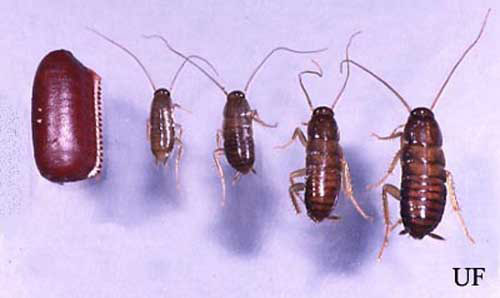
American cockroach - Periplaneta americana (Linnaeus)


You all are lucky if you’ve never had to deal with one of these hiding in your kitchen or basement. Unfortunately, I am one of the unlucky ones who’s had the misfortune of seeing their little antennae peek out through a wall (Fun fact: I have actually been bitten by one of them). A member of the taxa Blattodea, Periplaneta americana, more commonly known as the American cockroach, is a well-known pest in the United States. It is actually the greatest found house pest in the United States, which sucks but it could be spiders instead, so there’s a bright side! Before my research, I knew that they traveled in extremely large numbers; my knowledge was confirmed because after researching I found that they sometimes live in colonies with up to 5,000 cockroaches. These cockroaches live all throughout the United States, but there are fewer populations in the colder Northern states. They prefer moist areas such as mulch and soil around lakes and ponds. And to make matters even worse, fun fact: they can fly!


Citations:

(2019, August 20). 10 Gross Facts About American Cockroach Infestations. Pestco.com. Retrieved January 29, 2023, from https://www.pestco.com/10-gross-facts-american-cockroach-infestations/

Barbara, K. (2000). Common name: American cockroach scientific name: Periplaneta americana (Linnaeus) (Insecta: Blattodea: Blattidae). Featured Creatures.

PestWorld (n.d.). American Cockroaches. PestWorld.org. https://www.pestworld.org/pest-guide/cockroaches/american-cockroaches/