Our Favorite GSU Places

Tranquility on Campus

The Georgia State College of Law building is the most prominent and transformative addition to the Atlanta campus for students. The building at 85 Park Place opened on June 22, 2015, replacing what was once considered sub-par accommodations and lack of room for expansion for the university’s law and business students hosted in the Urban Life building. The College of Law building is Georgia State’s first-ever facility created specifically for legal education. It is LEED Gold certified, exemplifying the university’s aim of sustainability and innovation.

Today, this building has many different spaces designed for a multitude of uses. It features lecture halls, classrooms, faculty and administrative offices, a cafe on the first floor, and a dedicated law library with terrace space on the top two floors. The overall architectural aesthetic design of the building is nearly flawless, in my opinion. The combination of dark wood paneling, tall glass windows, and stone cladding creates a very serious yet tranquil energy throughout the building. The crown jewel would have to be the subtlety of green space provided on the terrace on the top floor.

Ever since discovering this building on campus, I have been drawn to the building’s serine and refined ambiance. It has provided me with a much-needed contrast to the bustling energy of the rest of the campus and Downtown Atlanta, allowing me to decompress briefly between or after classes. Whether filled with focused graduate students or supported by the kind, attentive faculty and staff, the building serves as a calm and welcoming refuge for learning, collaboration, and relaxation. I hope to see this thoughtful design reflected in Georgia State University’s future campus expansion and development with a dedication to elevating the student experience and supporting academic success.

The Secrets of the Viaducts: Atlanta’s Zero Mile Marker

My ignorance was not for lack of proximity – During my two semesters taking American Sign Language in the College of Education and Human Development, I overlooked one of Atlanta’s most notable historical markers. A mere 3 minute walk from it multiple times a week, I walked within a block of the marker without ever becoming aware of its existence.

If this historical marker is so significant, why is it so hard to spot?

While reflecting on that question, one might use the resource Google Street View, which is notorious for providing insight into even the most difficult of places. Perhaps it can be of use here. Can you spot Mile Marker Zero in the Street View? For reference, I’ve included a photo of the historical marker we’re looking for.

Need a hint? Even Google can’t help you here! Hidden from the watchful eyes of Google Street View, lies a marker of how Atlanta came to be the transportation hub it is today. When you’re walking down Decatur Street with a friend, pay closer attention to the inconspicuous bridge-like structure (known as a viaduct) off Kimball Way SE.

viaduct outside
inside the viaduct, trash litters the ground

Venture into the viaducts, if you dare!
Recommendation:
wear shoes you don’t care about
and follow the buddy system.


We made it, y’all! Welcome to the Mile Marker Zero, or Zero Mile Post.
Ready for some history?

Selfie

Atlanta was formerly known as ‘Terminus’ due to being at the end of the Western & Atlantic rail line. Mile Marker Zero has been at this location since 1842, after being moved slightly. The mile marker has gone through transformations over time. To give one example, the original mile marker was moved to the Atlanta Historical Society in Buckhead in 2018, and a replica now stands in its place. This was a controversial decision, and some historians argued that the original mile marker should remain under the central avenue viaduct. Other interesting tidbits of history include that the mile marker was protected with timber during the viaduct construction. Oh, and there was actually a building surrounding the mile marker, built in the 1980s, underneath the viaduct!

marker zero

Thank you for joining me on a Venture to the Viaducts. I hope you come away with a renewed sense of curiosity about the historical aspects of your daily surroundings! What histories are hidden right beneath your feet?

Standard Building

Not many students at GSU outside the School of Music even know this building exists. If you go to Aderhold along Luckie Street and continue across Forsyth Street past Rialto Theater, you’ll pass by a blue decorated window that is the lounge of Standard. However, you can’t enter from there. The actual entrance to the building is pretty nondescript and in the alleyway next door right by Aamar Indian Cuisine. This entrance is on Fairlie Street, which is different from its mailing address on Luckie Street.

The Standard Building is one of the oldest buildings on campus. It is nested on the same block as Rialto Center for the Arts and its cousin the Haas Howell Building along with other private businesses and residences. All 3 of the GSU owned properties are registered historic buildings due to their age and history and were purchased by GSU in the 1990s. Today they serve as the main buildings for the School of Music and its related programs, including the Rialto Center for Performing Arts. As the home for the School of Music, most of the students there spend time in the lounge on the first floor of the Standard Building, which has the window previously mentioned on Luckie Street. Curiously, unlike most other GSU buildings, access to Standard is restricted via PantherCard at all times and requires you to tap/swipe and use the automatic door opener, something that no other regular instructional building does. Haas Howell, its neighboring building, does not have such a restriction. The building contains a lounge for School of Music students, instrument storage, lockers, small classrooms, offices for music professors, and practice rooms complete with Steinway pianos.

Standard is by no means boring like its name might entail, especially to me. The building is definitely worthy of its historical place recognition. It is a former office building and lies in the Fairlie-Poplar Historic District. An original mail chute from when the building was still an office lines the elevator lobby across all floors of the building, albeit sealed off. Its architecture is certainly more intricate than its newer built GSU counterparts. From the view of the practice rooms inside you can see the original windows that lined the building and the intricate trim that was all the fashion of the time. It’s a very unique building at GSU and not a lot of people at the university know about its existence much less been inside of it. Despite not being a music major, I spend a decent amount of time there as many of my friends are music majors and I do play in a university ensemble so I do use the practice rooms there occasionally.

Lately, students at the School of Music have been critical about the state of the building as it is certainly showing its age. Both elevators are small and cramped. They are also prone to breaking down, and as of last semester there was a period of about 3 months where only 1 elevator was working for all 11 floors of the building. The HVAC system is notorious for making the building too hot in the winter and not cool enough in the summer. The stairs are small and not meant for students carrying instruments. The layout of floors is confusing and undocumented, meaning most people learn where things are by word of mouth or finding it themselves. The windows fixtures, ceiling, and drywall are in need of a refresh and aren’t in the best of shape. Regardless, Standard is an interesting, quirky building. It’s a part of GSU that is a bit unknown to most and more people should know about it.

WRAS Album 88

Established in 1971, GSU’s student-run radio station Album 88 was once at the “leading edge of your radio dial.” Broadcasting with the call sign WRAS (which stands for “Radio at State,” because WGSU was taken) on 88.5 FM, it is still very much around, but unfortunately Album 88’s glory days are long gone. In 2014, the school secretly sold off 14 hours of the daily airtime to NPR affiliate Georgia Public Broadcasting. The radio tower off of I-20 is still owned by the school, but the students only get to broadcast on the FM waves from 7pm-5am daily. However, the students stream their broadcast 24/7 online and on the 88.5 HD2 frequency which you can enable in some cars.

Album 88 was named for the station’s signature approach to its music rotation: playing multiple songs from each new album instead of only the big singles. The station created its brand in the 80s to differentiate itself from the other stations rather than just going by its call sign WRAS. Album 88 enjoyed massive listenership throughout the 1980s-2000s and helped popularize artists such as the B52s, REM, Outkast, and more. Today, the music consists of local and underground albums released in the past 6 months along with weekly specialty programming after 7pm.

The student station broadcasts within the Student Center West (formerly the University Center) room #271. Though it’s just a few unassuming doors from the outside, the multiple interconnected rooms are richly decorated with music posters, awards, stickers, drawings, and other mementos that serve as an archive in their own right, not to mention the walls of CDs and vinyl records. This picture of me is taken in the broadcast room, and you can see a little slice of the living archive on the walls (and every other surface). If you ever find yourself in SCW, you can knock on the door or peek in the window and someone might be willing to show you around!

Me sitting in a chair in the broadcast room, there is a mic to my right, a computer behind me, and lots of decorations on the walls

I’ve been involved with our radio station for two years and now hold the Promotions Director position, managing concert ticket giveaways and the social media among other things. The station is still persevering, we have 40+ DJs on the schedule with a few more in the training process, as well as 15 weekly specialty shows. Though it’s a shame that most GSU students don’t know we have a radio station at all anymore, I’ve found it to be an incredibly fulfilling experience to participate in. I don’t plan on going into the music/radio/entertainment industry, but my time at Album 88 has introduced me to so many friends and improved my confidence, and it’s truly just an awesome space to get to experience my college years in.

The Most Inconspicuous Monument in Downtown Atlanta

I pass by this monument everyday coming onto campus (the bus I take to campus lets us off just one block down from it). But the first time I really ever noticed it was on the “Women in Downtown Atlanta” walking tour with Amy Durrell that I went on for this course.

Selfie of the author with the Barbara Miller Asher statue in Downtown Atlanta

Barbara Miller Asher and I

The monument is a representation of Barbara Miller Asher. She gained community favor through 14 years of volunteer work and was elected to her first term as a city council member in Atlanta in 1977, serving multiple terms.1 The statue commemorating her is located on the intersection of Marietta St. NW and Broad St. NW in front of Broad Street Plaza.

I’m of the opinion that women should be taken much more seriously in history, and the records we have for women’s accomplishments and impacts should be under much more scrutiny. Barbara Miller Asher is no exception. I was almost able to find more information on the building of this monument and her marriage to her husband than I was on her achievements. Commemorating doesn’t even feel like the right word to describe the presence of a statue in her likeness. To me, it feels like more of just an acknowledgement that she existed.

I can’t help but compare the depictions of a woman to the depictions of a man. I believe it is very indicative to the culture’s attitude of women’s role in society. Here, while Barbara Miller Asher is at street-level, Henry Grady’s likeness (only one block down, also on Marietta St. NW) is much grander, being several feet above the road and holding a godlike stature above two women who look meek and in need of protecting. Barbara looks much more inviting. I’ve noticed that she has a smile on her face, her knees being bent makes her look less intimidating, and overall she just seems very welcoming. To me, her monument is a reminder that women are people, while statues commemorating men display that they get to assume the role of something more than that.

Since that walking tour, I know I’ll never be able to come to the Georgia State University campus without thinking of Barbara Miller Asher and women’s inescapable relegation to the background. In a way, her newfound prominence in my mind is already a stride in defeating that social norm.

  1. “Asher, Barbara Miller, November 20, 1985.” The Breman Museum , November 20, 1985. https://archivesspace.thebreman.org/repositories/2/archival_objects/27944. ↩︎

Downtown ATL’s history hides in plain sight

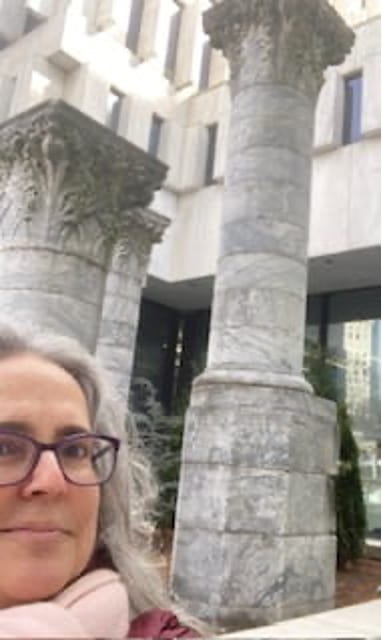
The big concrete plaza in front of 25 Park Place is kind of blah, but every once in a while I stop there to admire the marble columns in front of the building. They remind me that so many of Atlanta’s beautiful old structures have been destroyed and replaced by modern architecture. But I think it’s kind of sly that someone kept these pieces here, so we might ponder them. What were they? Why are they there now?

Dr. Davis in front of the Equitable columns at 25 Park Place NE
Dr. Davis and the columns

These three marble columns (and the façade behind it, inside the GSU Career Services center) were once part of the Equitable building, which stood where GSU’s CMII building is now. When it was built in 1892, it was the tallest skyscraper in the city (eight stories — back then that was a really tall building). It was originally known as the Trust Company of Georgia building.

When the building was demolished in 1971, its eighteen columns were scattered around the city. I have no idea why these three are here today, or how the building’s arched entrance came to be preserved and installed inside. Maybe the SunTrust Banks did it, when they owned this building?

However they got here, I’m always glad to notice these lovely pieces of craftsmanship. It feels like some weird random piece of old Atlanta has been plopped down on a barren and characterless public urban plaza. I dig the juxtaposition.