Barney and Scientist

Today we are going to be talking about Barney and his scientific friends who have done a lot of research on him. He thinks he’s popular because of this! To begin, Barnacles or Cirripedia are sessile crustaceans that live in marine environments from intertidal zones to the deep sea, some from the tropics to the polar regions and some will live on other marine animals. In the article “Genomic insights into the sessile life and biofouling of barnacles (Crustacea: Cirripedia), the authors talk about how barnacles represent a great model system for scientists to be able to study the evolution of body forms. 

In this article, the main study that was found was that barnacles have a highly reduced and simplified genome that is different compared to other crustaceans. Also, this article talked about how the identified genes are involved in barnacle adhesion, which is a critical aspect of biofouling. This being said evidence was found for the convergent evolution of the adhesive proteins that are in barnacles and other sessile organisms.

With that being said, the authors had a few different hypotheses about their research. One of the hypothesis that the researchers had was about barnacles’ adhesion and biofouling being facilitated by a unique set of genes and proteins. The study identified the genes being involved in barnacle adhesion and found evidence for the convergent evolution of adhesive proteins in barnacles. With the findings, the scientist suggested that these could have implications for developing many new approaches to help manage biofouling and prevent the spread of invasive species. 

From the results of this study, the major result was the identification of genetic and protein components involved in barnacle adhesion and biofouling. Researchers identified the genomic features that are specific to barnacles and that may be related to their sessile lifestyle. They found that throughout the research, the barnacle genome is highly reduced and simplified compared to other crustaceans. Barnacles have a relatively low number of genes and fewer genes that involved mobility and sensory perception. The study also provided insights into the evolutionary history of the barnacles and their relationship with other crustaceans. Throughout the study, the researchers were able to find that there is a close relationship between barnacles and parasitic crustaceans. 

The article had a few key points. One of those is that barnacles have a highly reduced and simplified genome compared to other crustaceans, which can reflect to their adaptation to a sessile lifestyle. This ties in with previous studies showing that petioleless marine organisms tend to have reduced genomes.

Key terms:

Biofouling-the fouling of pipes and underwater surfaces by organisms such as barnacles and algae.

Sessile- fixed in one place; immobile

Citations:

https://www.ncbi.nlm.nih.gov/pmc/articles/PMC8220330/


Barneys Family Tree

Welcome back to the greatest blog that has come from the depths of the ocean! I come back to tell you about my family/ancestors! In my family, there are about 1000+ species of barnacles. We all have a bunch of different characteristics that make us who we are. For example, we are all filter feeders! We use our little modified legs to capture planktonic food particles from the water. We have many more similarities but if I was to talk about them I would keep you here forever haha. However, we are not all just similar we have some differences too. Like our body structures, depending on our species within our group our body structure varies. Some of us have an elongated/flattened body shape while others have a more rounded or cylinder shape. There were unique features of interest that were used such as reducede body plan: the body plan of Cirripedia which is highly modified compared to other crustaceans. This body complexity has been a subject of interest. With that said, the types of data that was used would be the morphological data which would include the observation of the physical characteristics of differnt organisms. 

The one feature that would bring my family and me together would have to be the presence of our calcarous shell and our exoskeleton which encases our body. Our body is made with several plates that are fused togther because of calcium carbonate. This body part provides us with protection from predators. Whats crazy about my family is that our closest relatives are crabs and lobsters. So yes, I know what you guys are thinking… Mr. Krabs and Larry the Lobsters are related to me! However, we are different. The way that is in multiple different ways, but one of those many ways is our body plans. Crabs and lobsters are decapods and they have a cephalothorax which is fused to an abdomen while Cirripedias have an enclosed shell that is calcified. 

Phylogeny of the Rhizocephala. Adapted from Fig. 5 in the molecular phylogenetic analy - sis of Glenner and Hebsgaard (2006) by collapsing, where possible, branches to “family level”. The Akentrogonida (boldfaced taxa and lines) is monophyletic and nested within a paraphyletic Kentrogonida. The kentrogonid family Peltogastridae is paraphyletic because it also comprises Peltogasterella and Parthenopea. The speciose family Sacculinidae is similarly not monophy- letic. The “Sacculinidae A” includes the well-known Sacculina carcini , while “Sacculinidae B” comprises some other species of “ Sacculina ” and the genus Polyascus , removed from “ Sacculina” by Glenner et al. (2003). The Duplorbidae and Mycetomorphidae were not part of Glenner and Hebsgaard (2006). The position of the Duplorbidae is inferred from characters listed by Høeg and Rybakov (1992, 1996b), while data from the present paper indicate that the Mycetomor- phidae diverged low on the phylogeny of the Akentrogonida. The position of the Polysaccidae is based on sequence data from Polysaccus japonicus , but this species may not be closely related to P. mediterraneus studied here (see Fig. 5). The basal relation between the three cirripede orders was taken from Pérez-Losada et al. (2002). 

https://www.researchgate.net/figure/Phylogeny-of-the-Rhizocephala-Adapted-from-Fig-5-in-the-molecular-phylogenetic-analy_fig5_250016211


https://ucmp.berkeley.edu/arthropoda/crustacea/maxillopoda/cirripediasy.html#:~:text=There%20are%20approximately%201000%20species,groups%2C%20the%20Rhizocephala%20and%20Ascothoracica.

Crazy Facts About Me!


Untitled 1

Welcome back to my amazingly fascinating blog!! Since I am a very unique creature, I also comes with many unique features. I myself would say that I am BEAUTIFUL both on the inside and on the outside! Something that is really unique about me is that I sticks in large groups which means that my friends and I will be hanging out all the time together and hangout at one of our FAVORITE spots, The Rock ;). 

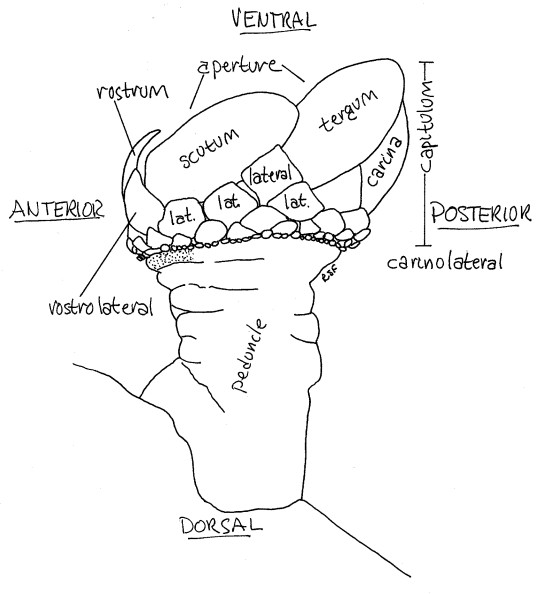
Barney has many anatomical features that will make him stand out from others. But one that that stood out to me about his physical features had to do with him having a peduncle. Which in this case of him having one means that he is able to attach to hard surfaces and the peduncle allows the barnacle to be more flexible and move around so that he can catch food. However, on the inside Barney is also really cool. He has a digestive system that he uses by filtering plankton and other small organisms which get broken down by the digestive enzymes. Something that is also really unique about Barney is that he has some really remarkable physiological adaptations. One fo these being the abilty to tolerate extreme conditions, that being super cold or super hot. For example, when these Barney and his friends are exposed to high temperatures, they close their shells to prevent from dehydration. Another thing about him is that he is able to reproduce in a really crazy way. He is hermaphroditic, which means he has both male and female organs, so he will give off sperm to a female Goose Barnacle and BOOM start creating babies! Or he can be the one that will be creating the babies! However, Barney is overall a really fascinating creature on the inside and on the out. The way he is able to adapt to his environment and surivive is insane!


https://www.brown.edu/news/2020-03-16/barnacles#:~:text=They%20build%20hard%20plates%20surrounding,tide%20and%20other%20harsh%20conditions.

https://www.wildlifetrusts.org/wildlife-explorer/marine/crustaceans/goose-barnacle#:~:text=Goose%20barnacles%20live%20attached%20to,looks%20like%20a%20black%20neck.

https://www.marlin.ac.uk/species/detail/43#:~:text=Pedunculate%2C%20goose%20or%20goose%2Dneck,and%20white%2Dgrey%20in%20colour.

https://www.britannica.com/animal/cirripede

https://lanwebs.lander.edu/faculty/rsfox/invertebrates/pollicipes.html

Barney the Barnacle!

Barnacle on whaleThemes of Parasitology: A Free Ride Under the Sea: Barnacles and Baleen  Whales

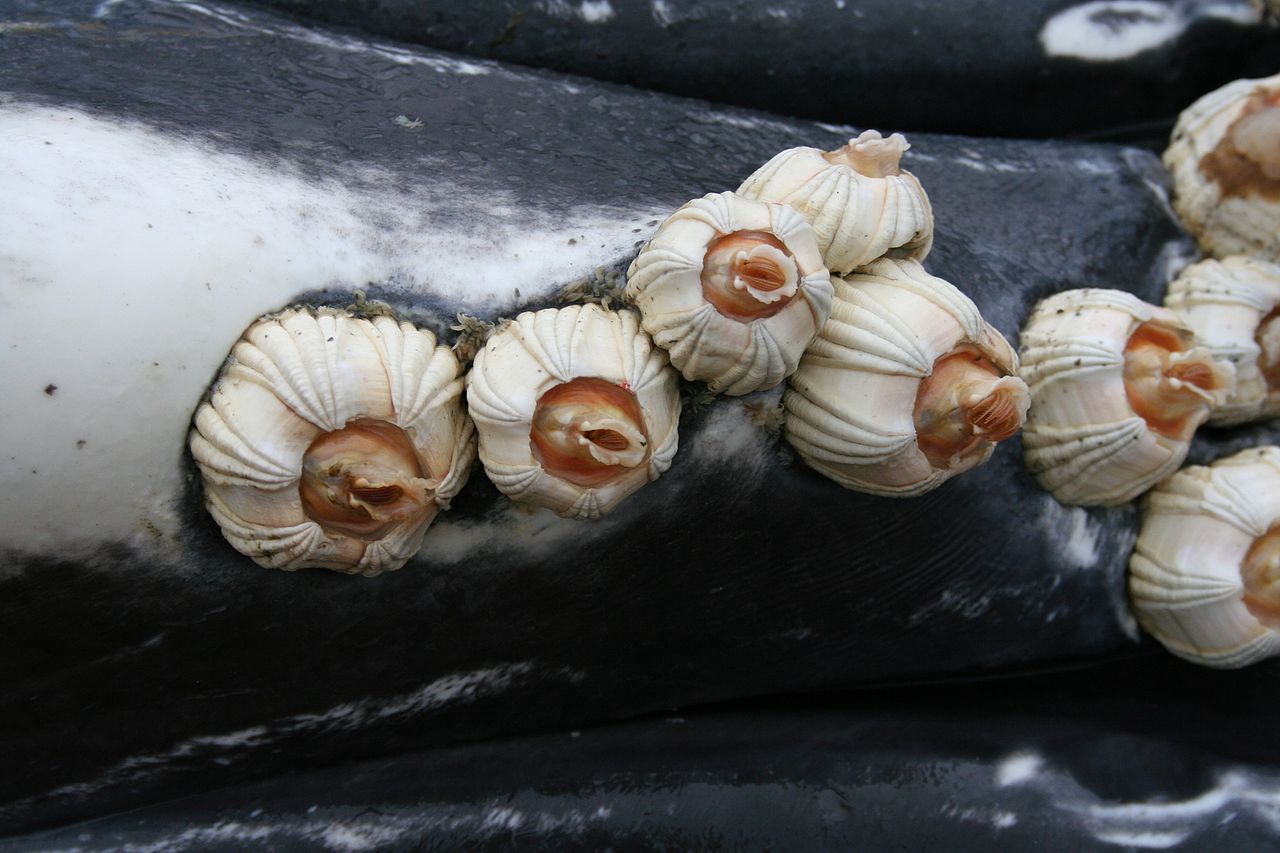
“BARNACLES”- SpongeBob :). When looking at the photo above, it’s safe to think what in the heck is that? But do not fear, it’s Barney the Barnacle. Barney is known as a goose barnacle and attaches itself to the skin of whales and other large marine animals (as seen in the picture). When being attached to the whale, the goose barnacle feeds on the food particles and debris that is found on the skin of the whale. These interesting creatures do not have to just attach themselves to living mammals or creatures, they can attach to ships and rocks too! The scientific name that categorizes Barney is known as Cirripedia. In latin he would be considered Cirripedia Thoracica.

The Cirripedia family belongs to the Arthopoda family. In this family there are a few other types of barnacles that are known as the Wart Barnacle, Acorn Barnacle and of course the Goose Barnacle. Prior to doing some research on barnacles, I knew they all have unique habitats. Goose barnacles in particular tend to live in rocky, coastal areas or the intertidal zone.

Something that is really interesting about barnacles is that they eat with their leg! (Did not think they had some from the way they look…) Another fact about these interesting crustaceans is that they can live on a single object for their entire life. So, that means that Barney will not be leaving his home ever!


Sources:

https://www.sciencedirect.com/topics/agricultural-and-biological-sciences/cirripedia

https://www.floridamuseum.ufl.edu/science/five-facts-barnacles/

https://www.dfo-mpo.gc.ca/species-especes/profiles-profils/goose-barnacle-pouce-pied-eng.html

http://bio390parasitology.blogspot.com/2012/03/free-ride-under-sea-barnacles-and.html


Meet Barney the Barnacle!

Barnacle on whaleThemes of Parasitology: A Free Ride Under the Sea: Barnacles and Baleen  Whales

“BARNACLES”- SpongeBob :). When looking at the photo above, it’s safe to think what in the heck is that? But do not fear, it’s Barney the Barnacle. Barney is known as a goose barnacle and attaches itself to the skin of whales and other large marine animals (as seen in the picture). When being attached to the whale, the goose barnacle feeds on the food particles and debris that is found on the skin of the whale. These interesting creatures do not have to just attach themselves to living mammals or creatures, they can attach to ships and rocks too! The scientific name that categorizes Barney is known as Cirripedia. In latin he would be considered Cirripedia Thoracica.

The Cirripedia family belongs to the Arthopoda family. In this family there are a few other types of barnacles that are known as the Wart Barnacle, Acorn Barnacle and of course the Goose Barnacle. Prior to doing some research on barnacles, I knew they all have unique habitats. Goose barnacles in particular tend to live in rocky, coastal areas or the intertidal zone.

Something that is really interesting about barnacles is that they eat with their leg! (Did not think they had some from the way they look…) Another fact about these interesting crustaceans is that they can live on a single object for their entire life. So, that means that Barney will not be leaving his home ever!


Sources:

https://www.sciencedirect.com/topics/agricultural-and-biological-sciences/cirripedia

https://www.floridamuseum.ufl.edu/science/five-facts-barnacles/

https://www.dfo-mpo.gc.ca/species-especes/profiles-profils/goose-barnacle-pouce-pied-eng.html

http://bio390parasitology.blogspot.com/2012/03/free-ride-under-sea-barnacles-and.html


Hello world!

Welcome to your brand new blog at sites@gsu.edu!

To get started, edit or delete this post and check out all the other options available to you.

For assistance, visit the comprehensive support site, check out the Edublogs User Guide guide or stop by The Edublogs Forums to chat with other edubloggers.

For personal support, you can attend Georgia State’s training on Edublogs or stop by The Exchange for one-on-one support.

You can also reference the free publication, The Edublogger, which is jammed with helpful tips, ideas and more.