
I will not lie, this was a difficult assignment for me. My family history is riddled with tales of drifters and early deaths, and unfortunately, those who probably knew more than they shared are in their graves. While I wish I had cared more about where I came from when these folks were around, some of the stories are lost. Nonetheless, I did manage to dig up a few interesting pieces of art that I feel reflect my cultural lineage.

This first work is a screenprint on Lenox Museum Board and was fashioned by Andy Warhol in 1986 as a part of his Cowboys and Indians portfolio. While many recognize this image as Annie Oakley, a famous American markswoman, her real name is Phoebe Ann Mosey, and she happens to be my relative. Her father and my great-great-grandfather were brothers making Annie and my great-grandmother first cousins. We often brag in our family that with this lineage we are all fantastic shots! Unfortunately, her story reflects the poverty-stricken childhood that she endured and after her mother was widowed twice, she was forced to move out and work as a caregiver at an infirmary [1]. However, she persevered through many years of mistreatment and made a name for herself with her skill [1]. By the time she was 15, she was able to return to her mother’s home and help support the family [1]. She is a symbol in our family of strength, and her legacy has proven that with hope and determination anything is possible.
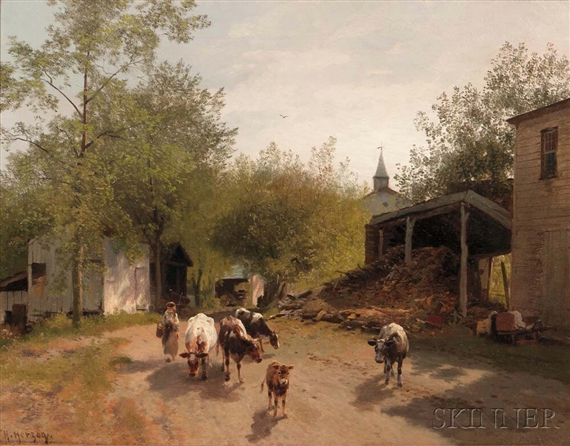
This second work is entitled Early Morning on the Farm and is an oil on canvas painted by Hermann Herzog. While the date of this work is unknown, Herzog was alive from 1832-1932 [2]. This work is significant for two reasons, Herzog was of German descent and migrated to America in 1871 settling in my home state of Pennsylvania [2]. He later became a citizen in 1876 and was known for painting landscapes of places he would visit [2]. While there is very little information on this painting, it does remind me of very early pictures of the Corle homestead that many generations of my mother’s family occupied. Just like the artist, this side of my family migrated from Germany as well and settle in Pennsylvania in the 1800’s. I have many fond memories of lazy summer weekends spent on the family farm where the work was never done, but my pap, his brother, and my uncles never seemed to mind. This picture reinforces to me that the perfect job is one that does not seem like work at all. It is amazing how a simple picture of herding Jersey cows to another pasture has the ability to take me back to a different place and time. I miss those days.
I thought I would share this little gem as well. This is a copper tea kettle that came “across the pond” from the old country. There is no date and no artist to give credit to, but it is a fascinating piece that was brought with my great-great-great grandmother when she migrated from Germany in the mid 1800’s.

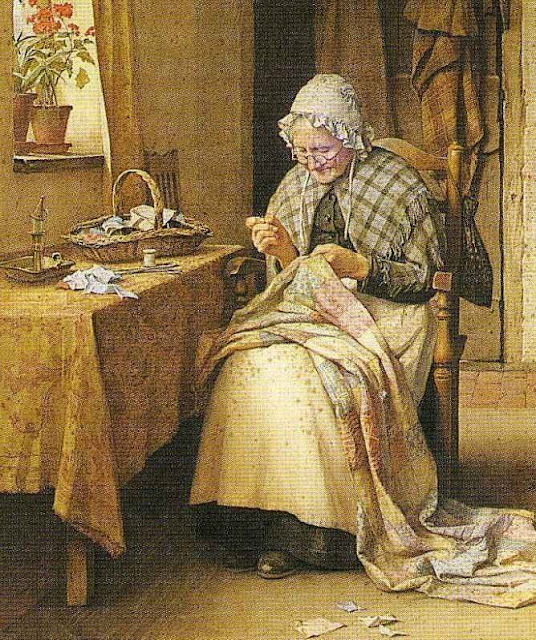
This next work I chose to showcase is called Making a Patchwork Quilt by British painter Charles Edward Wilson. It is no secret that I come from a long line of quilters with an ancestry that can be traced back to England and Germany. In this work, there is presumably a farm wife constructing a quilt from whatever material she had on hand. This could be from worn out bedding, clothes, or even chicken feed sacks. While quilting skills have been passed on from generation to generation, there has been a shift from necessity to simply creating something beautiful “just because.” What I find striking about this piece is the simplicity of the background with what appears to be an oak table, candle lamp, and house plants in the window. This environment has a very familiar feel and reminds me of my youth. Sturdy, humble surroundings that were not riddled with the materialistic possessions of the present day. Pastimes were not spent in front of a screen playing a game or trolling endlessly on social media; they were spent constructing real tangible items or finding true joy in caring for a plant. I feel very fortunate to know how to sew and quilt and find great satisfaction in watching a plant thrive. I am also glad that my own have taken a bit of interest in these pastimes as well.

I chose this final piece because of my maternal grandmother. Her mind is now lost to Alzheimer’s disease; however, when I was a little girl she would play on her organ the song “Ave Maria” which is based on the traditional Catholic prayer to Mary. This work by Sandro Botticelli, Madonna of the Magnificat, 1481-82, reflects the subject of the song, Mary, mother of Jesus Christ. His emphasis on the importance of Mary is detailed in the larger size of the work as well as the extensive use of gold paint to decorate her robe, crown, and portrayal of the divine rays of light [3]. It is also noted that she is being crowned the Queen of Heaven by the angels [3].My grandmother is Catholic, and even though I am not, I appreciate the praise that she had for Mary and now looking back I realize that she was sharing her convictions with me. In fact, Mary and the song devoted to her, “Ave Maria” was so important to her that I had it played in the prelude to my wedding.
When I look at all of the works that I chose to present in this final post, I realize two things. First, I have an unyielding desire, much like Annie Oakley, to succeed. Honestly, I am not sure I will ever be content. Life is too short to be ordinary and confined to preconceived boundaries, right? Secondly, the last three works speak of the fond memories that I had growing up. I think it is important to understand where we come from and what skills, as well as thoughts, we have developed as a result. This gives us a true sense of self and the greatest gift we can give to our younger generation is the continued traditions and skills that make us who we are. We are all very diverse beings with rich histories. It is important that we embrace that.
References
[1] http://www.biography.com/people/annie-oakley-9426141
[2] http://www.edwardanddeborahpollack.com/Herzogbiography.html
[3] http://www.wga.hu/frames-e.html?/html/b/botticel/22/30magnif.html


